

General information about Crete
Arrival in Crete
Crete is easily accessible by both air and sea. The island has two international airports in Heraklion and Chania, which are usually served by direct flights from many European cities.
Crete is also well connected by sea. Several ferry lines link the island to the Greek mainland, especially to the port of Piraeus near Athens, as well as to various islands in the Aegean Sea. If you plan to travel by ferry: www.minoan.gr/de

Climate in Crete
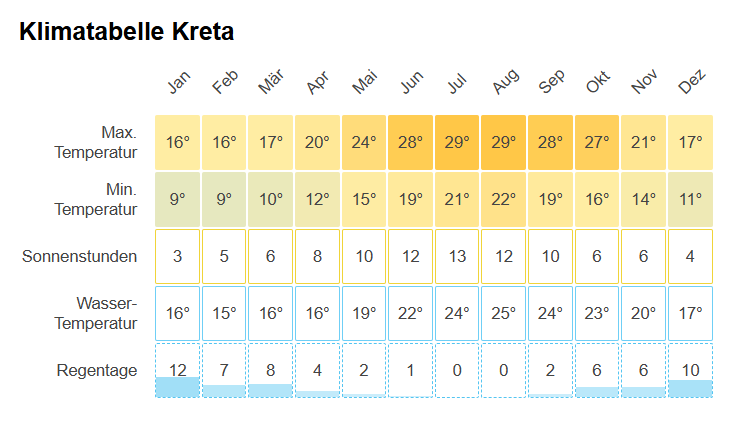
A true sun-drenched island – from the end of April to mid-October you can expect cloudless skies! With 300 days of sunshine a year, Crete, along with Cyprus, is the sunniest island in Greece and the entire Mediterranean. In summer, the thermometer climbs.
Temperatures often reach over 40 degrees Celsius, and on the south coast you can still venture into the water in December. In general, it's two or three degrees warmer there than in the north of the island.
Island data
At a glance
Size:
Crete is the largest island in Greece and, after Sicily, Sardinia, Cyprus, and Corsica, the fifth largest in the entire Mediterranean region. It covers approximately 8,300 km², stretches for about 260 km, and measures between 18 and 60 km in width, depending on the section.
Highest elevations:
The highest point on the island is Timios Stavros in the Ida Mountains (central Crete) at 2456 m. Only slightly lower – by just 4 m – is Pachnes in the Lefka Ori in the west of the island.
Levels:
The largest plain in Crete is the Messara Plain in the south-central part of the island, covering approximately 140 km². Other significant plains are located in the regions around Chania and Rethymno.
Population
Traffic:
Crete has two major ports: the port of Heraklion and Souda Bay near Chania. Other important ports of call are located in Kastelli, Rethymno, Agios Nikolaos, and Sitia. Three civilian airports are available for air traffic: Heraklion, Sternes on the Akrotiri peninsula near Chania, and Sitia. However, international flights are handled exclusively via the airports of Heraklion and Chania.
Business:
Only about a third of Crete's land area is suitable for agriculture. Olives and grapes are among the most important export products. Industry is limited and located only around Heraklion. Tourism, on the other hand, plays a central role and now shapes large parts of the island's economy. The distribution of guest beds clearly illustrates this: 53% are located in the Heraklion region, 24% in Lassithi, 12% in Rethymno, and 11% in the Chania region.
Administration:
Crete is divided into four administrative districts, the so-called Nomi:
- Chania with its capital city Chania
- Rethymno with its capital city Rethymno
- Heraklion with its capital Heraklion
- Lassithi with its capital Agios Nikolaos
Geography
First impression: Crete looks like a long mountain range rising from the sea. From a distance, the dark contours appear in the haze before the plane lands over the deep blue water.
The island lies like a mighty barrier on the southern edge of the Aegean Sea. Its mountains dominate the entire landscape. Four large mountain ranges define Crete's shape: In the center rises the Ida Mountains, to which legend attributes the birthplace of Zeus.
In the west, the Lefka Ori, the "White Mountains," dominate the landscape. In the east, the Dikti Mountains enclose the Lassithi Plateau with its windmills. Finally, in the far east, the Thripti Mountains form a narrow, striking mountain range.
To the north, the Cretan mountains descend into gentle hills and open onto wide coastal plains where the main cities and resorts are located. The south, especially the southwest, presents a completely different picture: here, the two-thousand-meter peaks drop off abruptly, forming dramatic cliffs dotted with small sandy and pebbly coves. Tiny villages huddle between high rock faces, often accessible only by boat, dusty tracks, or hiking trails.
The landscape offers impressive coastal routes and deep gorges that stretch for kilometers through the mountains. The famous Samaria Gorge – often described as the longest in Europe – is just one of many spectacular natural scenery.
Regions of Crete
West Crete:
Western Crete is the most mountainous and largest part of the island. The Lefka Ori, the "White Mountains," dominate the landscape with their barren, rocky peaks reaching almost 2,500 meters. Towards the south coast, they are dissected by deep gorges – most notably the famous Samaria Gorge and its impressive neighboring valleys. Only a few mountain passes cross these isolated heights and lead down to the small, remote villages along the Libyan Sea.
Center of Crete :
The hinterland of Heraklion is characterized by a vast, hilly landscape that forms the largest contiguous wine-growing region in Greece. To the west rises the imposing Ida Mountains, with Timios Stavros at 2,456 meters, the island's highest peak. A popular starting point is Anoghia, the center of the high mountain pastures with tens of thousands of sheep. From here, trails lead to the Nida Plateau and the famous Zeus Cave.
Further east rises the Dikti massif, easily accessible from the north coast and Agios Nikolaos. The ascent ends at the almost circular Lassithi plateau, which, according to mythology, is the birthplace of Zeus. Southern central Crete is dominated by the fertile Messara Plain, near which the famous cave dwellings of Matala are among the island's special attractions.
Eastern Crete:
The eastern part of the island is predominantly barren, dry, and rocky. The landscape is dominated by the grey Sitia Mountains, which rise to almost 1500 meters – wild, rugged, and sparsely developed. Agios Nikolaos has developed into a lively tourist town that, despite the hustle and bustle, has retained its special charm.
Among the scenic highlights are the expansive Mirabellou Bay, the famous palm-fringed beach of Vai, and the Minoan palace of Kato Zakros. Around Ierapetra, long stretches of grey pebble beaches along the south coast, perfect for swimming.
Heartless:
Southern Crete has a rugged and unspoiled feel. The mountains drop steeply to the coast, forming small, often secluded bays, some accessible only via narrow roads, tracks, or on foot. Quiet villages and long beaches dot the warm Libyan Sea, while deep gorges and lonely coastal paths offer breathtaking natural experiences. The fertile Messara Plain provides a verdant contrast.
Tradition
Cretan music:
The music of Crete is powerful, raw, and full of energy – quite unlike the rather gentle bouzouki music of the mainland. At its heart is the lyra, a traditional three-stringed bowed instrument made of mulberry wood, which shapes the island's distinctive sound.
Cretan dances:
Through dance, Cretans express their feelings directly. Alongside joy, sorrow, anger, and pain also find their place – dance here is an outlet for the entire spectrum of human emotions.
Cretan festivals:
Celebrations are frequent and passionate on Crete. All over the island, you'll find festivals, usually in honor of a saint or for local events. Music, dance, and shared meals make these celebrations vibrant encounters with Cretan culture.
To try
In the past, Cretan costumes varied from village to village and often showed Turkish or North African influences. Today, traditional clothing is rarely seen. Older men in the mountains occasionally wear the raka, wide black breeches, combined with boots or leg wraps and the sariki, a fringed headscarf. The elaborately embroidered vests and the red sash with the silver bounialo have almost disappeared. However, shepherds still use the sakouli, a colorful, handwoven backpack. The richly decorated women's costumes (sakkos and phousta) have now almost completely vanished from everyday life.
Church:
The church plays a central role in social life on Crete. It sees itself as a people's church and stands in the tradition of early Christianity. Services are informal and natural, even during solemn occasions. For many people, the church is an important meeting place and the social hub of the village. The Cretan Orthodox Church is directly under the authority of the Patriarch of Istanbul.
History
Early period and Minoan culture (c. 3000–1450 BC)
Crete is considered the cradle of the first highly developed European culture: the Minoan civilization.
- Centers such as Knossos, Phaistos, Malia and Kato Zakros shaped the island.
- The Minoans were excellent seafarers, traders, and artists.
- Their palaces, frescoes, and the Linear A script testify to a highly developed society.
- Around 1450 BC, the Minoan culture declined – presumably due to natural disasters (e.g. the volcanic eruption of Santorini) and later due to Mycenaean influences from the Greek mainland.
Mycenaean and Ancient Period (c. 1450–67 BC)
After the decline of the Minoans, the Mycenaeans took power.
Later, Crete became part of the Greek world, but remained politically fragmented.
During Roman times (from 67 BC onwards) the island became a peaceful, prosperous province.
Byzantine and Arab periods (4th–13th centuries)
After the division of the Roman Empire, Crete belonged to the Byzantine Empire.
- In the 9th century, Arab pirates conquered the island and founded an emirate.
- In 961 AD, the Byzantines recaptured Crete and Christianized it again.
Venetian rule (1204–1669)
After the Fourth Crusade, Crete fell to Venice.
This period shaped architecture, art, and cities such as Chania, Rethymno, and Heraklion.
The island experienced economic growth, but also uprisings against foreign rule.
Ottoman period (1669–1898)
After decades of fighting, the Ottomans conquered Crete.
The population suffered from high taxes and religious pressure, which led to numerous revolts.
In the 19th century, the desire for independence and union with Greece grew.
Autonomy and union with Greece (1898–1913)
Under international pressure, Crete became autonomous in 1898, with Prince George of Greece as High Commissioner.
The official union with Greece finally took place in 1913.
20th century and World War II
In May 1941, Crete became the scene of the famous Battle of Crete, when German paratroopers attacked the island.
The occupation was harsh, but the resistance of the population remains legendary to this day.
Modern times
After the war, Crete developed rapidly:
- Infrastructure expansion
- The rise of tourism
- Strengthening agriculture (olive oil, wine)
- Today, Crete is one of the most dynamic regions of Greece – culturally, economically, and in terms of tourism.
How to find us
Copyright ©2026 | Impressum